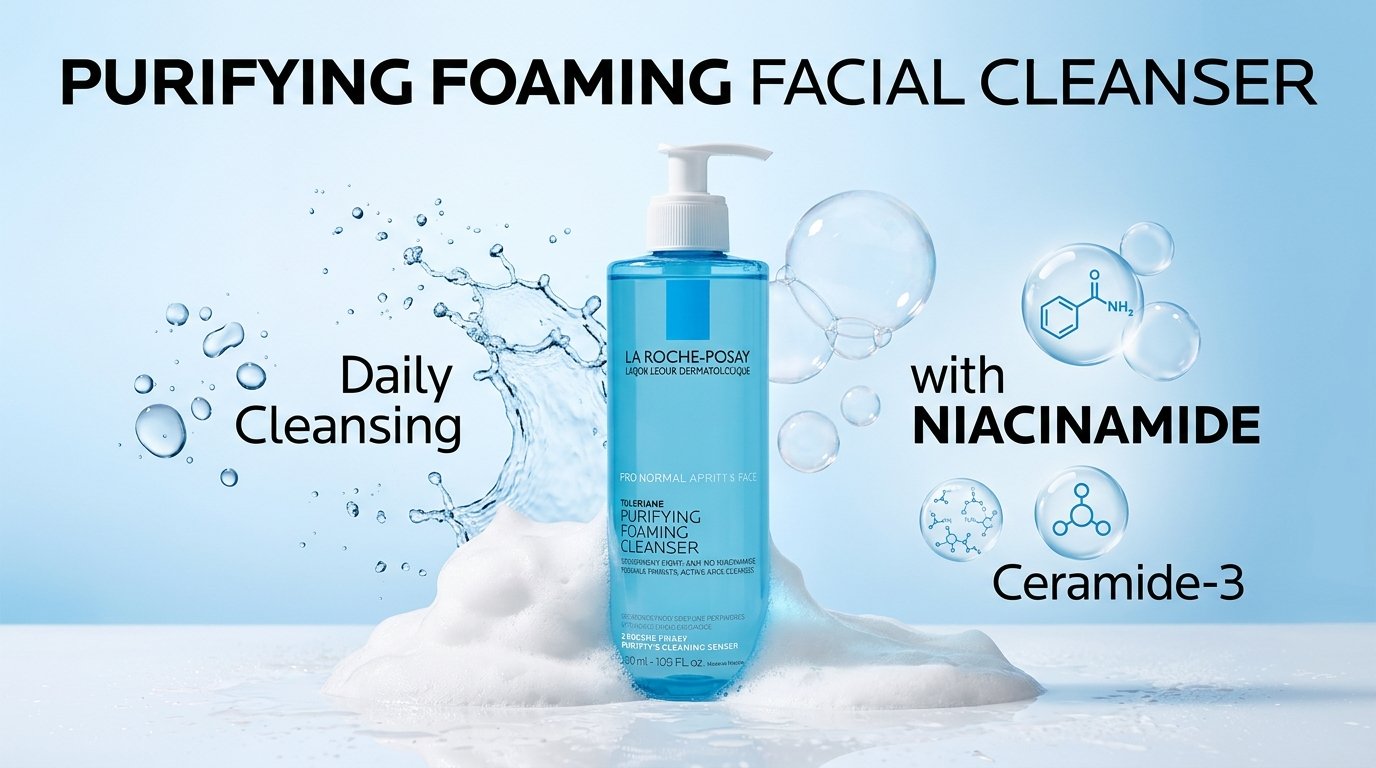
The La Roche-Posay Toleriane Purifying Foaming Facial Cleanser with Niacinamide is a daily foaming facial wash designed for normal-to-oily and combination skin, with sensitive skin listed among its recommended concerns. The brand says it cleanses dirt, makeup, and impurities while removing excess oil without disrupting the skin’s natural moisture barrier and pH.
Its formula contains several notable components:
- Niacinamide
- Ceramide NP
- Glycerin
- Coco-betaine
- Disodium cocoyl glycinate
- La Roche-Posay Prebiotic Thermal Water
- Tocopherol
The current official ingredient list places glycerin near the beginning of the formula and identifies both ceramide NP and niacinamide among the ingredients. As always, shoppers should check the ingredient list on their own packaging because cosmetic formulas can change.
What Type of Cleanser Is It?
This is fundamentally a foaming cleanser for normal, combination, and oily skin rather than a rich cream cleanser designed primarily for very dry skin.
That distinction matters. People who enjoy a fresh, rinsed-clean sensation may appreciate the format, while someone whose skin routinely feels tight after cleansing may prefer a more moisturizing cleanser.
What Makes La Roche-Posay Toleriane Purifying Foaming Facial Cleanser with Niacinamide Different?
The most interesting aspect of this cleanser is the way the formula combines a conventional foaming cleansing experience with ingredients associated with skin-barrier care.
La Roche-Posay specifically highlights niacinamide, ceramide-3/ceramide NP, glycerin, and its prebiotic thermal water. The brand describes ceramide NP as a skin-identical lipid that helps support the moisture barrier, while glycerin functions as a humectant.
That does not turn a rinse-off cleanser into a leave-on treatment. Contact time is relatively brief, so it is sensible to think of these ingredients as part of the overall formulation rather than expecting a cleanser to deliver the same type of results as a concentrated niacinamide serum.
The practical advantage is formula balance: cleansing remains the primary job, while the supporting ingredients are intended to make that cleansing experience more compatible with maintaining skin comfort.
Key Ingredients and How They Work
Niacinamide
Niacinamide is a form of vitamin B3 widely used in skincare. La Roche-Posay describes it as having soothing properties and says it helps restore the skin’s moisture barrier and visibly fade discoloration.
In this cleanser, I would view niacinamide primarily as a supporting skincare ingredient, not the reason to replace a dedicated treatment serum.
For people building a simple routine, however, having niacinamide within a daily cleanser can complement a broader barrier-focused approach.
Ceramide NP
Ceramides naturally occur in the skin and are important components of the skin barrier. La Roche-Posay identifies ceramide NP as a skin-identical lipid used to support the skin’s moisture barrier.
Its presence is particularly relevant when evaluating a foaming cleanser because consumers often worry that foaming automatically means harsh or drying. The presence of a barrier-supporting ingredient does not guarantee that every person will experience the same level of comfort, but it is a meaningful part of the formula’s design.
Glycerin
Glycerin is a humectant that helps attract and retain water. La Roche-Posay includes it among the product’s key ingredients.
In a cleanser, glycerin can help support a more comfortable cleansing experience, although it should not be confused with the prolonged hydration provided by a leave-on moisturizer.
Prebiotic Thermal Water
La Roche-Posay identifies its prebiotic thermal water as a core ingredient in many of its products and describes it as a soothing water sourced in La Roche-Posay, France.
For shoppers interested in the brand’s dermatological positioning, this ingredient is part of the broader formulation story rather than a standalone reason to purchase the cleanser.
How Does La Roche-Posay Toleriane Purifying Foaming Facial Cleanser with Niacinamide Feel and Perform?
The official directions recommend using it morning and evening on the face. The brand instructs users to wet the face with lukewarm water, apply the cleanser using circular motions, rinse, and gently pat the skin dry.
The foaming format should appeal most to people who prefer a cleanser that feels refreshing rather than creamy.
Morning Use
In the morning, the cleanser can provide a straightforward way to remove overnight oil and prepare the skin for moisturizer and sunscreen.
Evening Use
At night, it makes more sense as part of a routine designed to remove accumulated oil, impurities, and makeup. Heavy or long-wearing makeup may still require an appropriate first cleansing step depending on the products being worn.
The Important Question: Does It Feel Stripping?
This is where individual skin type matters.
La Roche-Posay states that the formula removes excess oil while maintaining the skin’s natural moisture barrier and pH and says it leaves skin feeling clean, fresh, and comfortable.
Those are manufacturer claims, not a substitute for individual experience. Someone with very dry or highly reactive skin may still prefer a less foaming format.
Who Should Consider This Cleanser?
Best for Oily Skin
This is arguably where the product makes the most obvious sense. La Roche-Posay specifically recommends it for oily skin and highlights its ability to remove excess oil.
If your main complaint is that your face becomes shiny or greasy during the day, a purifying foaming cleanser can be a logical category to consider.
Best for Combination Skin
Combination skin often needs a middle ground. The T-zone may need effective cleansing while the cheeks can be more sensitive to over-cleansing.
Because La Roche-Posay lists normal/combination skin among the recommended skin types, this cleanser may suit people looking for a balanced daily wash rather than a heavy-duty oil-control treatment.
Best for Sensitive Skin
The brand specifically lists sensitive skin as a concern and identifies the cleanser as dermatologist tested.
Still, “suitable for sensitive skin” does not mean universally irritation-proof. Individual sensitivities differ, and anyone with a history of reactions should review the complete ingredient list carefully.
What About Dry Skin?
This is where I would be more cautious.
The formula is built around a foaming cleansing experience and is primarily positioned toward normal, combination, and oily skin. Someone with persistently dry skin may prefer a cleanser specifically designed around richer hydration.
How to Use La Roche-Posay Toleriane Purifying Foaming Facial Cleanser with Niacinamide
Using it does not need to be complicated.
- Wet your face with lukewarm water.
- Apply an appropriate amount of cleanser.
- Massage gently in circular motions.
- Rinse thoroughly.
- Pat rather than aggressively rubbing the skin dry.
- Follow with moisturizer.
- During daytime, finish with sunscreen.
La Roche-Posay officially recommends morning and evening use and specifically advises lukewarm water and gentle application.
The biggest mistake is assuming that more cleanser or longer rubbing equals cleaner skin. Effective cleansing should be efficient, not aggressive.
La Roche-Posay Toleriane Purifying Foaming Facial Cleanser with Niacinamide vs. Other Cleansers
Two useful alternatives are CeraVe Foaming Facial Cleanser and Cetaphil Daily Facial Cleanser. Both are also positioned toward normal-to-oily skin and include niacinamide, making them relevant comparisons rather than arbitrary competitors.
| Feature | La Roche-Posay Toleriane Purifying | CeraVe Foaming Cleanser | Cetaphil Daily Facial Cleanser |
|---|---|---|---|
| Primary Skin Types | Normal/combination, oily | Normal to oily | Normal to oily |
| Niacinamide | Yes | Yes | Yes |
| Ceramides | Ceramide NP | Three essential ceramides | No ceramide listed |
| Other Notable Ingredients | Glycerin, thermal water | Hyaluronic acid, ceramides | Panthenol, glycerin |
| Format | Foaming facial wash | Foaming gel | Gel-to-foam |
| Best Fit | Oily/combination sensitive skin | Normal-to-oily skin | Combination-to-oily skin |
| Barrier Focus | Niacinamide + ceramide NP | Ceramides + hyaluronic acid + niacinamide | Niacinamide + panthenol + glycerin |
CeraVe states that its foaming cleanser contains three essential ceramides, hyaluronic acid, and niacinamide and is designed for normal-to-oily skin. Cetaphil describes its Daily Facial Cleanser as a gel-to-foam formula with niacinamide, panthenol, and glycerin for normal-to-oily skin.
The comparison shows why there is no universal “best” cleanser. The right choice depends on which supporting ingredients and sensory experience fit your routine.
Pros and Cons
Pros
- Designed specifically for normal, combination, and oily skin.
- Includes niacinamide and ceramide NP.
- Contains glycerin as a humectant.
- Foaming format provides a fresh cleansing experience.
- Brand states that it removes excess oil while maintaining the natural moisture barrier and pH.
- Suitable for morning and evening use according to the manufacturer’s directions.
Cons
- The foaming format may not be the first choice for people with very dry skin.
- Individual sensitivity can vary even with a cleanser marketed for sensitive skin.
- Niacinamide in a rinse-off cleanser should not be treated as equivalent to a dedicated niacinamide treatment.
- Shoppers should check the current packaging for the latest ingredient list.
Is La Roche-Posay Toleriane Purifying Foaming Facial Cleanser with Niacinamide Worth It?
For the right skin type, the formula makes a compelling case.
The strongest argument for La Roche-Posay Toleriane Purifying Foaming Facial Cleanser with Niacinamide is its positioning between effective cleansing and barrier-conscious skincare. It is especially logical for normal, combination, and oily skin, while the brand also specifically identifies sensitive skin as a concern.
I would not choose it simply because it contains niacinamide. Instead, I would choose it if I wanted a foaming cleanser that combines oil and impurity removal with ingredients such as glycerin and ceramide NP.
If your skin is very dry and easily feels tight after washing, a more hydrating cleanser may make more sense. Likewise, if you already have a cleanser that keeps your skin comfortable and balanced, switching products is not automatically an upgrade.
Frequently Asked Questions
Is La Roche-Posay Toleriane Purifying Foaming Facial Cleanser with Niacinamide good for oily skin?
Yes. La Roche-Posay specifically recommends the cleanser for oily skin and says it removes excess oil while maintaining the skin’s natural moisture barrier and pH.
Is it suitable for sensitive skin?
The brand lists sensitive skin as a recommended concern and describes the product as dermatologist tested. However, individual sensitivities vary, so review the current ingredient list before use.
Does La Roche-Posay Toleriane Purifying Foaming Facial Cleanser contain niacinamide?
Yes. Niacinamide appears in the manufacturer’s published ingredient list and is identified as one of the product’s key ingredients.
Can I use this cleanser every day?
The manufacturer recommends using it morning and evening.
Is it suitable for combination skin?
Yes. La Roche-Posay lists normal/combination skin among the recommended skin types.
Can I use it in both my morning and evening routines?
Yes. The official directions specify morning and evening use.
What should I use after this cleanser?
A simple routine can follow with a suitable treatment or serum, moisturizer, and—during the day—broad-spectrum sunscreen. The best combination depends on your skin type and concerns.
Final Verdict
La Roche-Posay Toleriane Purifying Foaming Facial Cleanser with Niacinamide is most compelling for people who want a refreshing foaming cleanser without abandoning a barrier-conscious skincare approach.
Its combination of niacinamide, ceramide NP, glycerin, and the brand’s thermal water gives the formula more substance than a basic oil-removing face wash. La Roche-Posay also specifically positions it for normal/combination and oily skin and lists sensitive skin among its recommended concerns.
The key limitation is equally straightforward: a foaming cleanser is not automatically ideal for every complexion. Very dry skin may respond better to a more hydrating format.
For normal, combination, or oily skin—particularly for someone who enjoys a foaming wash—the formula is worth considering. The smartest approach is to judge it not by how much foam it produces, but by whether it leaves your skin clean, comfortable, and ready for the rest of your routine.
 abirhasanofficial789@gmail.com